As manufacturing evolves, OEMs are focusing on quality, speed, and supply chain stability. This overview of 2026 injection molding trends covers everything from predictive AI to regionalization, with real-world perspectives from Kaysun’s subject matter experts.
The trends shaping injection molding in 2026 illustrate the ongoing shift in how parts are engineered, manufactured, and delivered. From advances in smart automation and predictive AI to regionalized supply chains and optimized materials, these trends are influencing how OEMs source suppliers.
At Kaysun, we don’t stop at watching trends. We embrace and execute them in ways that create tangible value for customers and keep us on the cutting edge of engineered excellence.
Industry 4.0 has matured into the norm of injection molding, yet many manufacturers are still only in the data-collection phase. Not so at Kaysun.
“We’ve been on our Industry 4.0 journey for six and a half years,” said Bob Reeves, VP of Operations. “Today we have over 100 custom dashboards built in-house, tailored to every department. They’re used daily to drive data-based decisions in real-time that improve quality, efficiency, and profitability.”
This real-time infrastructure supports Kaysun’s advanced AI systems like RJG Co-Pilot, which helps the team move from reactive troubleshooting to proactive management. Reeves explained, “AI studies our process data for a few months, learns what good and bad looks like, and then tells us when something is trending out of spec before it becomes a scrap issue.”
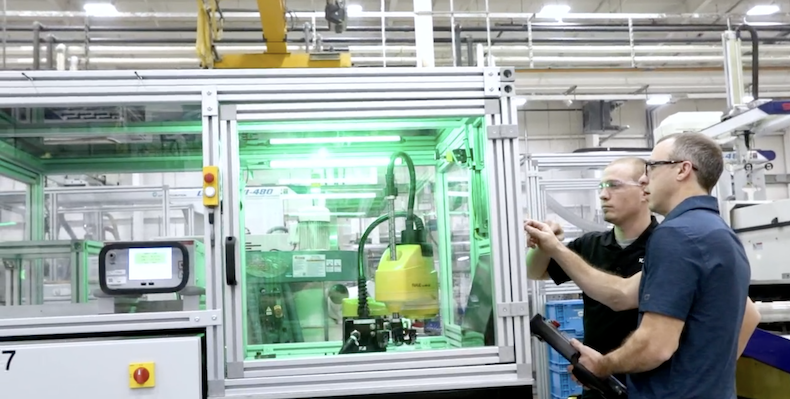
Once a strategic advantage, automation is foundational to modern injection molding operations. As manufacturing complexity increases, automation facilitates greater precision, scalability, and process reliability.
Jake Schnell, Kaysun’s Maintenance & Automation Supervisor, underscored the shift:
“Ten years ago, automation was a nice-to-have. Now, it’s mission-critical to maintain pricing, quality, and consistency.”
Automating repetitive, labor-intensive tasks like insert molding has reduced the risk of human error, and freed up workers to focus on higher-value tasks without the worry of compromised quality. “With robotics handling the inserts, we’ve eliminated human inconsistencies and drastically improved repeatability,” Schnell noted.
Wayne Hurkmans, Kaysun Automation Technician, sees alternative programming platforms for industrial automation as a related beneficial trend.
“There are many new ways to program these systems now,” said Schnell. “It’s becoming more adaptable, more efficient, and more scalable, especially for customized part designs.”
AI is integrated into frontline operations for manufacturers, particularly in defect detection. Kaysun’s use of AI-powered vision systems is already outperforming human inspectors, and quality assurance is next-level.
“For some applications, we use AI to make part quality decisions instead of people. The setup is very intuitive,” explained Brian Knier, Kaysun Automotive Technician. “We tell it what is good and what is bad, and it figures out everything in-between.”
This zero-defect mindset is particularly valuable to OEMs in regulated markets like medical and automotive, where product integrity is critical and often lifesaving.
While automation and AI grab headlines, regionalization may be the sleeper trend in sourcing strategies in 2026. As tariffs fluctuate and offshore logistics remain unpredictable, OEMs continue to re-evaluate their supply chains.
“Regionalization was a driver behind most of our quotes last year,” said Heather Kinzel, Kaysun Supply Chain Manager. “Customers want shorter supply chains, tariff protection, and predictable lead times. That’s sparking regionalization.” Kaysun is well-positioned to deliver. Kinzel notes:
“The Midwest, and Wisconsin in particular, offers a great labor pool, logistical stability, and fewer environmental constraints than the coasts.”
With over 98% on-time delivery and minimal offshore dependencies, Kaysun stands out as a low-risk, high-performance partner.
Kaysun is transparent about suppliers to ensure long-term supply chain stability for OEMs.
“We’re upfront about lead times and supplier reliability before a program even starts,” Kinzel explained. “If we know one resin supplier has stronger historical performance or better risk posture, we’ll guide our customer in that direction. Our goal is to prevent surprises later.”
The biggest trends of 2026 serve as a path forward for Kaysun. Whether it’s predictive AI, advanced automation, strategic supply positioning, or engineering-rich collaboration, Kaysun is leaning into what’s next to deliver the complex injection molding performance OEMs expect and deserve.
Trends in injection molding, or any industry, are indicative of growth and change in manufacturing. Having the right suppliers by your side is essential to navigate shifting expectations and business strategies.
Download 5 Questions OEMs Must Ask Before Partnering With A Custom Injection Molder to access a framework for evaluating molders based on key credentials.

What are the biggest injection molding trends in 2026?Key trends include predictive AI for process and quality control, automation as a labor offset and quality enhancer, regionalized supply chains, and early-stage strategic supplier-OEM collaboration.
How is AI used in injection molding?
AI is progressively applied to two main areas: process monitoring and quality control. Predictive algorithms can analyze production data in real time to flag potential issues before defects occur, while AI-powered vision systems inspect parts with higher accuracy and consistency than manual inspection.
Why is regional manufacturing important?
Regionalization helps mitigate risks associated with tariffs, long lead times, and global logistics disruptions. It also enables better alignment with customer timelines and offers greater transparency in the supply chain.
What makes Kaysun distinctly different from other injection molders?
Kaysun is well-known for expertise in complex, high-precision molding for traditional and highly regulated markets. As a preferred OEM in major industries, the promise of Engineered Excellence is deeply rooted in the implementation of AI and automation, proactive risk management, and reliability as demonstrated by a 98% on-time delivery rate.


Challenge A manufacturer of handheld gas detection instrumentation brought Kaysun …
READ MORE
The 30-Second Summary Most medical OEM supplier audits confirm compliance but ofte…
READ MORE

The 30-second Summary ISO 13485:2016 is the international quality management syste…
READ MORE