
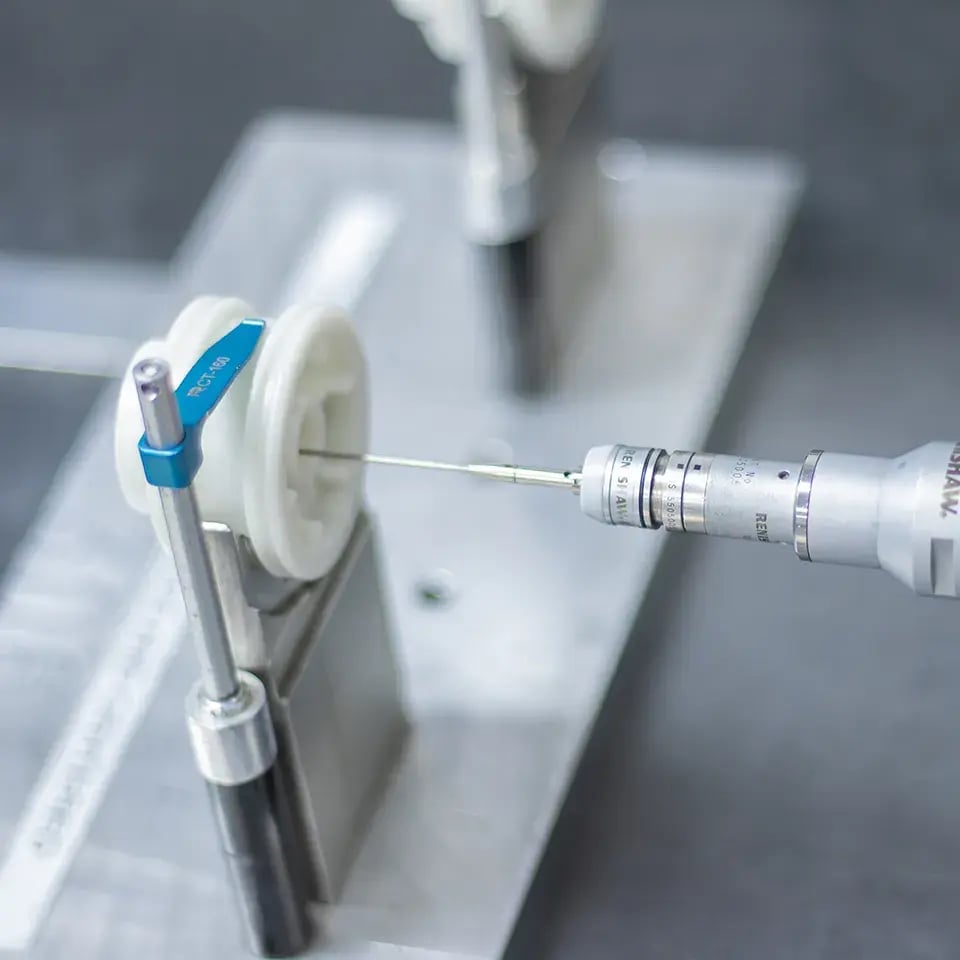



Medical Injection Molding Compliance ISO 13485 Certified. MedAccred Accredited. Audit-Ready from Day One.

Overview


  • The challenge: Medical OEMs navigate a dense landscape of regulatory standards, audit requirements, and validation protocols

  • The standard: Compliant injection molders make regulatory compliance a feature built into the program, not an afterthought

  • The pillars: Certifications, process validation (IQ/OQ/PQ), quality management systems, and traceability

  • The outcome: Audit-ready programs from day one, with documentation to match

clipboard-checkmark-icon-white

What Sets a Compliant Molder Apart

Medical device manufacturing operates under some of the most rigorous regulatory and quality expectations in any industry. For OEMs navigating program launches, selecting the right injection molding partner is a compliance decision.

A truly compliant molder doesn’t simply clear a quality checklist. They build regulatory standards into how they design tools, qualify processes, select materials, and document production.

What Does Compliance Mean in Medical Injection Molding?

Compliance in medical injection molding is the documented ability to produce parts that meet regulatory requirements, consistently and repeatably, across the full program lifecycle.

It rests on four interlocking pillars:

  • Certifications & Accreditations: Third-party verification that a molder’s capabilities and quality systems meet recognized industry and regulatory standards.
  • Process Validation: Documented proof, through IQ, OQ, and PQ, that the injection molding process consistently produces conforming parts.
  • Quality Management Systems: The operational infrastructure (FMEAs, control plans, SPC, corrective action) that keeps processes in control.
  • Traceability: Full lot control, device history records, and material documentation that satisfy FDA, MDR, or notified-body requirements at any audit touchpoint.

Critically, compliance isn’t a final inspection step. It applies equally to design, tooling, production, and documentation. A molder that only engages with compliance at end-of-line is not a compliant molder. They’re a risk.

Certifications & Accreditations That Signal a Compliant Molder

Not all quality credentials are equal in medical injection molding. Understanding what each certification actually requires and what it signals about a molder’s capabilities is essential for accurate supplier evaluation.

Related Resources

WhitepaperIconWhite

Group 211

MedAccred Plastics Accreditation

MedAccred is an industry-managed accreditation program that audits specific process disciplines within the medical device supply chain. For injection molding, MedAccred Plastics accreditation goes substantially further than ISO 13485, with auditors evaluating process-level execution: tooling integrity, scientific molding practices, process validation rigor, material controls, and operator competency.

Kaysun has held MedAccred Plastics accreditation since 2020, a differentiator that most injection molders cannot claim. For OEMs sourcing critical components, MedAccred accreditation provides a level of supply chain confidence that generic certifications simply cannot replicate.

iso-logo

ISO 13485:2016 Certification

ISO 13485 places heightened emphasis on risk management, regulatory compliance, process validation, and product traceability throughout the device lifecycle.

For OEMs, ISO 13485 certification from an injection molding partner means the supplier operates under a documented QMS explicitly aligned with medical device regulatory requirements. Kaysun holds ISO 13485:2016 certification.


New Medical Device Program? 

Process Validation in Medical Injection Molding


Certifications establish that a quality management system exists. Process validation proves that the system works in practice. IQ/OQ/PQ validation is where audit-readiness gets built, and often where many molders fall short.

process

Related Resources

Installation Qualification (IQ)

IQ confirms that equipment, tooling, and the production environment are installed correctly and to specification. This includes verifying that presses, molds, auxiliary equipment, and facility utilities meet defined requirements before any process development begins. IQ documentation becomes the baseline record against which future changes are measured.

Operational Qualification (OQ)

OQ establishes that the molding process operates within defined parameter limits and produces acceptable output under worst-case conditions. This phase involves systematic process characterization that maps the relationship between process inputs (temperature, pressure, cycle time) and part outputs to define a robust, controllable process window.

Performance Qualification (PQ)

PQ is the final validation stage: demonstrating that the process consistently produces conforming parts under real production conditions across a statistically significant number of runs. PQ output typically includes dimensional and functional data, cavity-pressure analysis, and process capability metrics (Cpk/Ppk) that confirm the process is in statistical control before commercial production begins.

When Revalidation Is Required

Revalidation is a planning consideration that belongs at the beginning of every program. Change-triggered revalidation may be required for material substitutions, mold modifications (including repair and regrind), equipment changes, facility relocations, or shifts in process parameters outside the validated range. Kaysun addresses revalidation proactively during program planning so OEM quality teams aren’t caught off-guard when changes occur.

Quality Management Systems (QMS) in Medical Molding Compliance

A Quality Management System (QMS) is the operational infrastructure that connects every element of a compliant molding program: process documentation, risk management (FMEA), control plans, corrective and preventive action (CAPA), supplier controls, and ongoing in-process monitoring.

For auditors and OEM quality teams, a molder’s QMS is the primary lens through which compliance is evaluated. A well-documented, actively maintained QMS demonstrates that quality is a managed outcome instead of an inspected-in afterthought.

Kaysun’s QMS approach includes:

  • Scientific molding with cavity-pressure monitoring for repeatable, documented production runs
  • In-process SPC with Cpk/Ppk analysis to maintain process capability and proactively manage variation
  • Documented quality plans developed for every program, including control plans and FMEAs
  • CAPA systems structured to identify root cause and prevent recurrence
  • Supplier qualification and control documented to align with ISO 13485 and MedAccred requirements

The result is a QMS that gives OEM quality teams confidence and documentation that stands up to auditor scrutiny.

beenhere

Related Resources

pencil-ruler-icon-white

Materials Selection as a Compliance Requirement


Buyers focused on process validation and certification credentials sometimes underestimate how much materials selection contributes to, or could undermine, a device’s compliance posture. In medical injection molding, material choice is itself a regulatory discipline, and the consequences of getting it wrong can surface long after launch.

Kaysun’s materials expertise helps OEM teams navigate four compliance-critical dimensions:

selecting_a_partner

Related Resources

Biocompatibility & Safety

ISO 10993 testing requirements, device contact classification (body contact, duration, nature), and additive and colorant considerations that can affect biocompatibility approval all must be evaluated before resin selection is finalized.

Sterilization Compatibility

ETO, steam autoclave, gamma/e-beam radiation, and chemical disinfection compatibility vary significantly across resin families. Selecting a material without mapping sterilization requirements can result in degradation, dimensional change, or loss of mechanical properties in service.

Mechanical Performance

Stiffness, impact resistance, fatigue behavior, optical clarity, and colorant stability all factor into long-term device performance. Kaysun’s engineers evaluate material behavior across the full range of use conditions, not just standard ASTM properties.

Regulatory Traceability

Full material provenance of resin lot, supplier, additive and colorant sourcing is essential for device history records and audit response. Kaysun’s traceability systems capture and maintain this documentation throughout the program lifecycle.

ChecklistIconWhite

Traceability: The Backbone of Medical Molding Compliance

Full traceability is the thread that connects every element of a compliant medical molding program. In the event of a quality event, regulatory inquiry, or field complaint, traceability documentation is what allows an OEM to reconstruct exactly what was produced, when, with what materials, on what equipment, and under what process conditions.

Kaysun’s traceability systems are structured to support audit readiness at any point in the program lifecycle, including:

  • Lot control: Serialized tracking of production runs, material lots, and tool states across every order.
  • Device history records (DHR): Complete production documentation aligned with FDA 21 CFR Part 820 and MDR requirements.
  • Raw material documentation: Resin certificates of conformance, lot numbers, supplier qualification records, and additive/colorant traceability.
  • In-process data capture: Cavity-pressure curves, SPC data, and inspection records retained for regulatory review.
  • Tooling and equipment records: Maintenance history, qualification status, and change documentation for every mold and press.

For OEM quality teams, robust traceability from a molding partner means fewer surprises in audits, faster CAPA response, and a documented foundation for regulatory submissions and renewals.

Preparing for a Medical Injection Molding Compliance Audit

Knowing what to look for when conducting supplier audits and what a well-structured molder’s responses should sound like makes the difference between a productive qualification visit and a compliance blind spot.

Related Resources

employee-badge-icon-white
Note these key audit checkpoints:

  • Certification documentation: ISO 13485 and MedAccred certificates should be current, accessible, and tied to the specific facility and process scope being audited.
  • Validation packages: Complete IQ, OQ, and PQ protocol and report packages should be available for any validated program. Gaps or incomplete closures are red flags.
  • QMS documentation: Control plans, FMEAs, and CAPA records should be active, version-controlled documents, not static files created for the last audit.
  • In-process monitoring data: SPC data, cavity-pressure records, and capability indices (Cpk/Ppk) should be readily retrievable and show a history of in-control production.
  • Material traceability records: Resin certificates of conformance, supplier qualifications, and lot-level documentation should be retrievable for every production run.
  • Tooling audit status: Tooling maintenance history, qualification records, and any documented changes or repairs should be current and complete.

Is Your Injection Molder Audit-Ready?

How Kaysun Builds Compliance Into Every Medical Program

Compliance isn’t a layer Kaysun adds at the end of a medical program. It’s the structure every program is built on from early design engagement through final production documentation.

  • MedAccred Plastics + ISO 13485:2016: Accredited since 2020. Both credentials are current, audit-verified, and applied to every medical program Kaysun runs.
  • IQ/OQ/PQ Validation: Customized to align with OEM SOPs and regulatory requirements — not templated packages applied uniformly across programs.
  • Scientific Molding: Cavity-pressure monitoring and data-driven process parameters deliver repeatable, documented production across presses and runs.
  • Full Material Traceability: Lot-level control and device history recordkeeping structured to meet FDA, MDR, and notified-body requirements.
  • In-Process SPC: Cpk/Ppk capability analysis on every production program, with real-time data to proactively manage quality variation.
  • Early Engineering Involvement: DfM and mold flow analysis from concept through tooling to compress timelines, reduce rework risk, and de-risk validation.

Related Resources

pencil-ruler-icon-white

FAQs

What certifications should a medical injection molder have?

ISO 13485:2016 is the baseline — it signals a QMS built specifically for medical device manufacturing. MedAccred Plastics accreditation goes further, requiring audited performance against specific process disciplines, not just documentation. Depending on your program, FDA establishment registration awareness and ITAR compliance may also be relevant. Kaysun holds both ISO 13485:2016 certification and MedAccred Plastics accreditation.

Is process validation required for all medical injection-molded parts?

Not universally. Validation is typically required for Class II and III devices, or any component directly tied to patient safety, dosage control, or critical performance. Class I may require only limited verification. The right level depends on your device classification, regulatory pathway, and risk assessment. Your molding partner should help you determine that early.

What is the difference between IQ, OQ, and PQ in medical injection molding?

Installation Qualification (IQ) verifies equipment and tooling are installed correctly. Operational Qualification (OQ) establishes that the process operates within defined limits under worst-case conditions. Performance Qualification (PQ) demonstrates consistent production of conforming parts over a statistically significant run. Together, they provide documented proof the process is controlled and repeatable before commercial production begins.

How do I evaluate a medical molder’s compliance posture during an audit?

Look for six things: current ISO 13485 and MedAccred certificates; complete IQ/OQ/PQ packages; active control plans, FMEAs, and CAPA records; retrievable SPC data and capability analysis; material traceability and supplier qualification files; and tooling maintenance history. A well-prepared molder produces all of it without extended lead time — audit readiness should be a continuous state.

What traceability documentation should a medical molder provide?

Expect lot-level production records, device history records (DHR), raw material certificates of conformance, in-process monitoring data (SPC, cavity-pressure, inspection results), and tooling and equipment records. All of it should be retrievable by production lot and available to support audit response, regulatory submissions, or CAPA investigations at any point in the program lifecycle.

What triggers revalidation of a medical injection molding process?

Revalidation is typically required after material substitutions, mold modifications or repairs, equipment changes, process parameter shifts outside the validated range, or facility relocations. Some quality systems also require periodic revalidation on a set schedule. A strong change-control process evaluates every modification against the validated state before production resumes.

applications

Compliance Starts with the Right Molding Partner

Request a consultation with our experts to discuss your next medical program and how Kaysun can help.