
Injection Molding Validation Playbook for Medical OEMs

Medical device programs live or die on process stability. A validated injection molding process that strays six months into production creates scrap, triggers investigations, and can put a launch timeline at risk.

Validation is how you prevent that. Done well, it produces evidence that the process will hold. Done narrowly, it produces paperwork that satisfies a protocol and little else.

This page covers what robust validation demonstrates, and what engineering, quality, and purchasing each need to verify before a medical program goes into production.

What Is Injection Molding Validation?

The 30-second Summary

Injection molding validation is the documented proof that a molding process consistently produces parts that meet predetermined specifications. For medical components, it's executed through IQ, OQ, and PQ protocols. Robust validation demonstrates five things: the process is defined through experimentation, controlled within verified limits, measured against capability metrics, traceable across production runs, and documented for audit readiness.

In regulated medical manufacturing, validation does more than complete required protocols. It establishes evidence that the injection molding process will remain stable and repeatable over time, under real production conditions rather than ideal ones.

This distinction matters, because the protocols themselves don't guarantee it. Two suppliers can both produce a complete IQ/OQ/PQ package and arrive at very different levels of production risk.

Why Validated Injection Molding Processes Still Fail

A medical component completes validation. IQ, OQ, and PQ protocols are executed. Documentation is approved. The program moves into production.

Months later, variability shows up. Parts drift toward tolerance limits. Scrap increases. Engineering reviews the process and confirms parameters remain within specification. Quality confirms the protocol was followed and documentation is complete.

The process still isn't stable.

This is more common than medical OEM teams expect, and it usually isn't because validation was skipped. It's because validation didn't account for the realities of production variation.

Three gaps that show up after production starts

  • Process windows are too narrow to absorb real-world variability. A process validated at nominal settings has no defined room to move

  • Documentation structures make root-cause analysis difficult. When something drifts, the records don't support finding out why

  • Supplier processes can't maintain long-term stability. The process was capable during qualification and hasn't been able to hold since

Why the Same Program Looks Different to Each Department

These gaps persist because validation gets evaluated through three different lenses inside an OEM, and each one sees a different risk.

Four Levels of Validation Maturity

Not every validation program demonstrates the same process maturity, and the difference translates directly into production risk.

1

Protocol-based

IQ/OQ/PQ with minimal process development

High risk
2

Parameter-based

Process parameters documented, limited experimentation

Moderate risk
3

Scientifically defined

DOE-defined process window and verified capability

Low–moderate
4

Fully controlled

Integrated traceability, change control, monitoring

Low risk
Higher risk Lower risk

Moving up this scale isn't a single department's job; it requires coordination across engineering, quality, and purchasing.

The Validation Stability Framework

Five principles define a stable validated process. This table maps how each one is owned across the three departments, and where the work is shared.

Principle
Engineering
Quality
Purchasing
Defined
DOE studies establish process window
Validation protocols documented
Supplier demonstrates process development capability
Controlled
Process limits verified during qualification

Change control and monitoring systems maintain stability

Supplier quality systems enforce process discipline
Measured
Capability studies verify tolerance performance

Inspection systems confirm ongoing performance

Supplier provides capability data and validation records
Traceable
Machine parameters and tooling documented

Materials, machines, and inspection records linked

Traceability supports audit readiness
Documented
Engineering validation reports

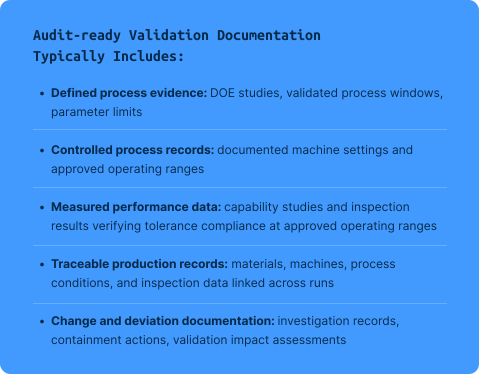
Audit-ready validation documentation

Supplier validation records available for review
Healthcare-Diagnostic Streamline Ultimate-Lt-Blue

Engineering's Role in Validation: Proving the Process Is Robust

ENGINEERING:

4 QUICK VALIDATION TAKEAWAYS

1

Validation must establish a true process window, not just nominal settings.

2

DOE studies should define measurable parameter limits.

3

Process capability must support medical tolerance requirements.

4

Tooling and DfM decisions influence validation stability.

Engineering teams are responsible for making sure the process holds under realistic production conditions, not just the conditions present on qualification day.

Process Window Robustness

Robust validation defines the acceptable operating range for key processing variables. Instead of validating one nominal setting, engineers determine the range of conditions across which the process stays consistent and capable.

Validated Process Window Example

Setting Mold temp (°F) Hold pressure (psi) Cooling time(s)
Low 280 2,500 4
Nominal 300 5,000 6
High 320 7,500 8

Scientific molding and design of experiments

DOE shows engineers how processing variables interact and where the boundaries sit that maintain part quality. Factor combinations get tested across high, nominal, and low settings to identify operating limits, variable interactions, and the conditions that produce dimensional drift.

Those DOE parameters come out of a series of scientific injection molding studies run in advance: rheology curve, velocity linearity, load sensitivity, pressure loss, dynamic check ring, gate seal, mold temperature, hold pressure, cavity balance where applicable, and shrink curve analyses. Together they confirm that equipment, tooling, and process are capable and unconstrained, and they define the DOE factors by testing operational limits.

Any issue surfaced during these studies has to be resolved and the study repeated before the program advances to DOE. Justifications and molded parts used to establish DOE settings should be documented and retained through final approval, both to defend the selected limits and to provide reference examples of what defects look like when the process runs outside the approved range.
Tooling and DfM decisions that affect validation

Part geometry and tooling design influence how sensitive a process is. Certain design features raise the odds of a future re-validation event when small process changes occur.

Identifying high-risk areas from design, process, and tooling standpoints during DfM analysis — before tooling kickoff — is what creates the opportunity to reduce that exposure before steel is cut. Where design changes aren't feasible, tooling strategies like building in replaceability for critical components can still mitigate risk.

It's also the right time to identify spare components tied to critical dimensions, so they can be included in the original validation submittal. Adding them later costs substantially more in both budget and schedule.

Material behavior and process capability

Material variation between lots affects process performance. Capability studies determine whether the process reliably produces parts inside medical tolerance requirements.

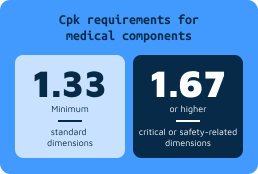
These requirements are verified at both the upper and lower operating limits established during OQ, which confirms the process is capable across the full window. Verification is also performed at nominal settings during the PQ run to validate performance under standard production conditions.

Cpk-requirements

Bandwidth and Scalability

Engineering also has to consider whether the validated process stays stable as production volumes increase. A process that's capable at qualification volumes isn't automatically capable at full production.

ENGINEERING:

VALIDATION QUESTIONS

1

Has the process window been validated across realistic operating limits?

2

Were DOE studies used to define parameter boundaries?

3

Do capability metrics support medical tolerance requirements?

4

How resilient is the process to material variation?

5

Can the process remain stable as production volumes increase?

Certified-Ribbon Streamline Ultimate-Lt-Blue

Quality's Role in Validation: Keeping the Process Controlled and Traceable

QUALITY:

4 QUICK VALIDATION TAKEAWAYS

1

Validation documentation must be audit-defensible.

2

Traceability should connect materials, machines, and inspection data.

3

Change control protects the integrity of validated processes.

4

Measurement, inspection, and monitoring systems must support tight medical requirements and detect process drift.

Quality systems are what keep validation defensible across the full product lifecycle, not just at approval.

Compliance and Audit Readiness

Mature medical injection molders maintain structured documentation showing that processes were defined, controlled, and verified under regulated conditions.

A complete, organized validation record reinforces alignment with Good Manufacturing Practices reflected in completed IQ/OQ/PQ validation reports.

Card L3

Production and lot traceability

Medical molders need systems linking finished components to the materials, equipment, process conditions, and inspection results tied to each production run. In robust environments, those records capture raw material lot numbers and supplier certifications, molding machines and mold tools with cavity identification, documented molding parameters and approved machine settings, and both in-process and final inspection data.

That's what makes it possible to investigate a deviation, contain a specific lot rather than a broad one, and verify that validated molding conditions stayed in control.
Measurement and inspection capability

A process can only be called measured and controlled if the verification methods can support the required tolerances. For tight-tolerance medical components, that can mean CMM for dimensional verification and CT scanning for internal feature analysis or complex geometry assessment.

Change control

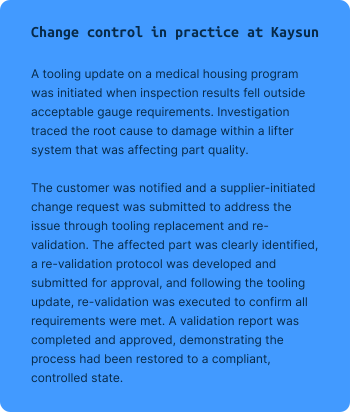
Structured change control keeps process adjustments from compromising validation integrity. That means evaluating whether a change affects tooling, materials, processing parameters, inspection methods, or documented acceptance criteria.

Deviation documentation requires three things: the portion of the protocol not properly met, the root cause explaining why, and the action plan addressing it.

Card L4


Preventing process drift

Monitoring systems catch variation early. That matters in injection molding validation specifically, because a process can look acceptable at qualification and still drift over time when controls are weak.

Established quality systems and certifications, including ISO certification and MedAccred accreditation, are useful indicators that these disciplines exist and have been tested under demanding audit conditions.

QUALITY:

VALIDATION QUESTIONS

1

Can validation documentation withstand regulatory audits?

2

Are deviations documented clearly and completely?

3

Does change control preserve validation integrity?

4

Is traceability maintained across production runs?

5

Are measurement and inspection methods capable of supporting medical tolerances?

6

Are monitoring systems in place to detect process drift?

Tags-Double Streamline Ultimate

Purchasing's Role in Validation: Evaluating Supplier Readiness

PURCHASING:

4 QUICK VALIDATION TAKEAWAYS

1

Supplier validation maturity affects program risk.

2

Weak process development often leads to re-validation events.

3

Documentation discipline signals quality system maturity and reduces downstream disruption.

4

Suppliers must demonstrate scalable production capability.

Supplier Quality System Maturity

Mature suppliers show disciplined documentation, strong process control, structured change management, and repeatable traceability. Those systems let production history be reconstructed quickly when something goes wrong.

In a dimensional deviation, that means rapidly identifying the affected lot, tracing it to a specific material batch and molding cavity, reviewing recorded process parameters, and isolating impacted components.

Supplier immaturity creates cost downstream, and the cost multiplies based on where the defect gets caught.

Cost Multiplier — Severity Bar

Assessing Supplier Validation Risk

A scorecard breaking risk down by factor makes supplier comparison more consistent.

Factor
Low Risk
Moderate Risk
High Risk
Process development
DOE-defined process window
Limited experimentation
Nominal-only validation
Quality systems
Mature traceability

Partial documentation

Weak documentation
Capability data
Verified Cp/Cpk metrics

Limited capability data

No capability analysis
Change control
Structured procedures

Informal processes

No formal system

Capacity and Scalability

Production stability has to hold as demand increases. Purchasing teams should evaluate whether a supplier has the bandwidth, process discipline, and supporting systems to scale without destabilizing a validated process.

PURCHASING:

VALIDATION QUESTIONS

1

Does the supplier demonstrate scientific molding capability?

2

Are quality systems mature enough for regulated production?

3

Can validation documentation support regulatory audits?

4

What is the potential cost of re-validation?

5

Can the supplier scale production without destabilizing the process?

What Robust Validation Demonstrates

Across all three departments, the same five principles separate a validation program that holds from one that only looks complete.
1

Defined

Process limits established through experimentation

2

Controlled

Monitoring systems maintain stability

3

Measured

Capability metrics verify tolerance performance

4

Traceable

Materials, machines, and records connected

5

Documented

Validation records structured for audit readiness

What Weak Validation Actually Costs

When validation doesn't account for real production conditions, the cost shows up well beyond the molding process itself:

1

Engineering rework — additional experimentation to stabilize the process

2

Tooling modifications — adjustments that may trigger partial or full re-validation

3

Regulatory documentation updates — changes affecting validation records and submission packages

4

Production delays — process instability affecting launch timelines

5

Supplier transition risk — in severe cases, a supplier change and full requalification

Let’s Talk

If you're evaluating validation readiness for an upcoming medical program, starting the conversation early helps identify risk before production begins.

Connect with the Kaysun team to explore how partnering with a custom injection molding leader supports stable, repeatable processes and defensible validation.